
Single-, double- and triple-primed canvas generally describe the number of priming applications or production stages claimed by a manufacturer. The number alone does not show how the finished painting surface will behave. A triple-primed canvas is not automatically better than a well-made double primed canvas, and double priming is not automatically better than a single application.
The finished surface depends on the complete preparation system: the base fabric, sizing where used, primer or ground formulation, solids and application amount, application method, drying between stages, surface finishing, coverage, adhesion, flexibility, absorbency, tooth and production consistency. For wholesale or private-label sourcing, primer count is useful only when it is considered together with these factors and an approved physical sample.
What Does “Primed Canvas” Actually Mean?
Priming prepares artist canvas for painting. The prepared surface sits between the woven fabric and the artist’s paint, and it can influence how readily paint moves, how much liquid is absorbed, how much drag the brush encounters and how clearly the weave remains visible.
A primed surface may be smooth or textured, relatively absorbent or less absorbent, and visibly woven or more completely filled. These characteristics cannot be identified from the word primed alone. They depend on the fabric and the complete surface-preparation process.
Different artist-canvas systems may also use separate sizing and ground stages, while other systems use a preparation that performs more than one function. This is why an artist canvas roll should be evaluated as a finished painting surface rather than by one production term in isolation.
Sizing vs Priming vs Ground: Are They the Same Thing?
These terms are related, but they are not exact synonyms in every artist-canvas system.
- Sizing typically refers to a preparatory treatment applied to fabric before the painting ground in systems where sizing is used. It seals or modifies the fabric and separates it from later layers.
- Primer or ground creates or contributes to the prepared painting surface. It can affect adhesion, absorbency, tooth, surface color and the prominence of the weave.
- Gesso is widely used as a commercial name for an artist ground. Traditional glue-and-whiting gesso and modern acrylic products sold as “acrylic gesso” are not chemically identical.
Manufacturers do not always use these words in exactly the same way. A product specification should therefore identify the intended painting medium and the actual prepared surface, not rely only on the label used for one preparation material.
What Does Single-Primed Canvas Mean?
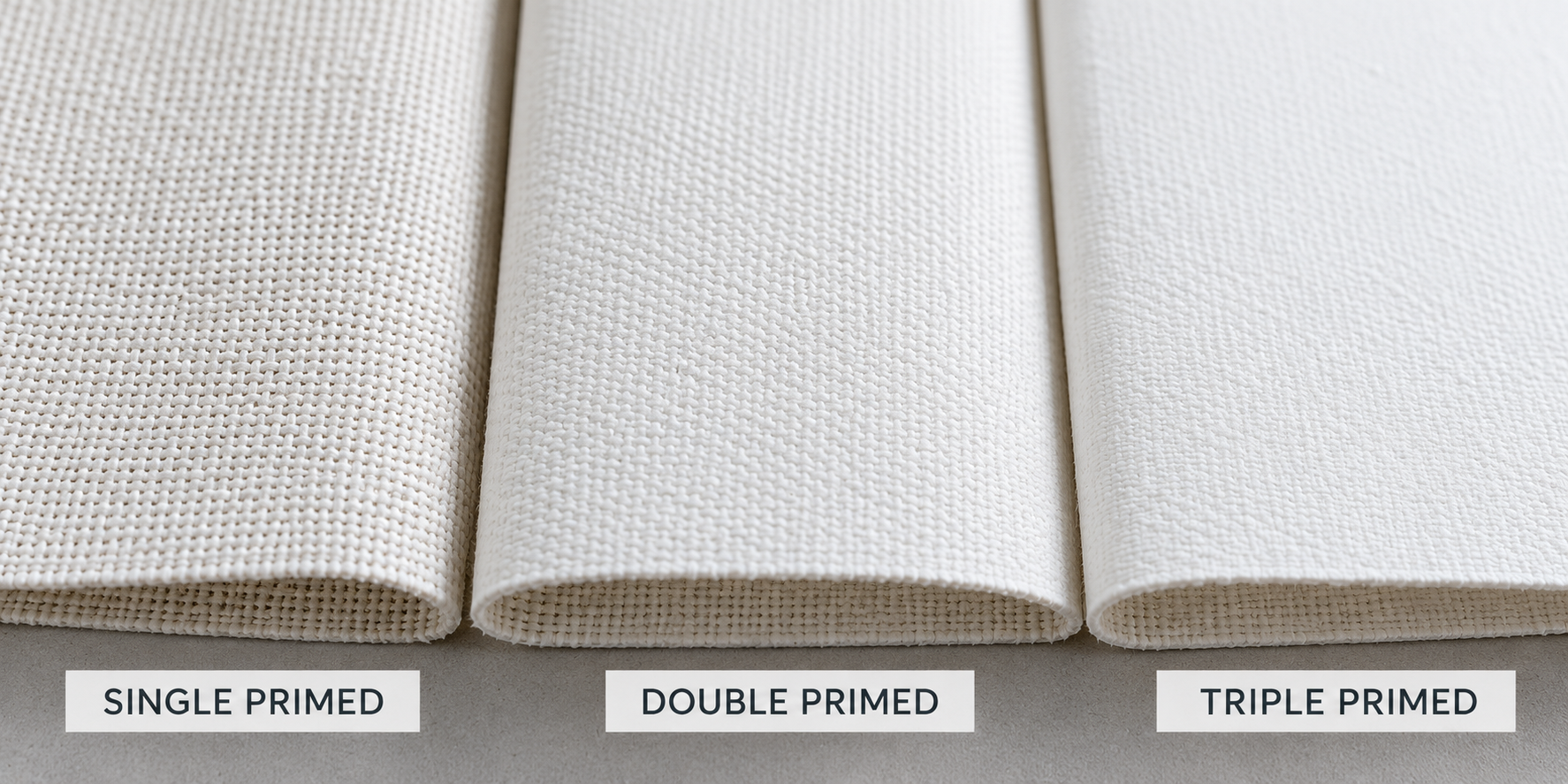
Single-primed canvas generally indicates one primer or ground application, or one defined priming stage, according to that manufacturer’s terminology. Depending on the formulation and process, the finished canvas may retain more visible weave, have a lighter surface build or provide a particular level of tooth and absorbency.
These are possibilities, not universal results. One application can vary considerably in solids, viscosity, application amount, method and coverage. A single application from one supplier is therefore not automatically equivalent to a single application from another.
What Does Double-Primed Canvas Mean?
Double primed canvas normally indicates two priming applications or stages within the supplier’s production system. A second application may be used to improve coverage, adjust surface uniformity, modify texture or build the intended painting ground.
However, “double primed” is not a universal technical specification. It does not by itself guarantee a smoother, stronger, less absorbent or more durable canvas. The two applications must still be considered in relation to the base fabric, formulation, quantity applied, drying process and final finishing.
What Does Triple-Primed Canvas Mean?
Triple-primed canvas generally refers to a third priming application or stage in a manufacturer’s process. That additional stage may be used to build coverage, refine the surface, control visible texture or produce another intended surface characteristic.
Triple primed does not mean premium by definition. A three-stage system with inconsistent application or unsuitable formulation may be less appropriate for a project than a controlled two-stage system. Even the way stages are counted can differ: some manufacturers describe preparation using both priming terminology and a separate number of paint applications. Always ask how the supplier defines the term.
Single vs Double vs Triple Primed Canvas
| Description | What It Usually Refers To | Possible Surface Effect | What Buyers Must Verify |
|---|---|---|---|
| Single primed | One stated primer or ground application or stage | May leave more weave visible or create a lighter surface build | Coverage, tooth, absorbency, intended medium and sample consistency |
| Double primed | Two stated applications or stages in the supplier’s system | May increase coverage or modify uniformity and texture | How the supplier counts stages, total surface build and finished painting response |
| Triple primed | Three stated applications or stages in the supplier’s system | May further build or refine the prepared surface | Formulation, application control, flexibility, surface finish and repeatability |
Does More Primer Make Artist Canvas Better?
No. Primer count is only one part of the specification. Formulation, solids, application weight, uniformity, adhesion, drying, flexibility, finishing and compatibility with the intended painting medium all contribute to the finished surface.
For repeat B2B orders, a consistent approved surface is more useful than simply requesting the highest possible coat count. The objective is not to maximize applications; it is to obtain the required painting response and reproduce it reliably.
Does More Priming Make Canvas Smoother?
Additional applications can fill more of the underlying weave or create a more built surface, but only when the formulation, application amount and finishing process produce that result. Fabric weave, primer rheology, application method and sanding or other finishing where used also influence smoothness.
A triple-primed surface can therefore retain more texture than a double-primed surface made on a finer weave or finished differently. Grain and smoothness should be checked directly on the sample rather than inferred from primer count.
How Does Priming Affect Canvas Tooth and Absorbency?
The prepared surface can influence brush drag, paint hold, paint flow, absorbency and visible texture. A ground with pronounced tooth may give the brush more resistance, while another surface may feel smoother. Absorbency also changes how paint and medium behave during application.
There is no dependable formula in which more primer always means less absorbency or less tooth. Formulation and finishing remain decisive. Two canvases both described as double primed can have noticeably different painting responses.
Does Primer Count Affect Canvas Flexibility?
Surface build and formulation can affect the feel and flexibility of prepared canvas, but coat count alone cannot predict flexibility or cracking behavior. The base fabric, preparation materials, application amount, drying and later handling work together as a system.
This matters when canvas will be rolled, stretched or converted after preparation. Flex and handle the actual sample in a way that represents the intended production process, without treating single, double or triple priming as a durability rating.
Acrylic-Primed vs Oil-Primed Canvas: Is Primer Count the Main Difference?
No. The type of primer or ground and the intended painting medium can be more important than the stated number of applications. Acrylic-primed, oil-primed and products marketed as universal primed canvas are not identical categories.
Check the supplier’s specification for the intended medium and prepared surface. A double-primed acrylic ground and a double-primed oil ground should not be assumed to provide the same absorbency, tooth or brush response simply because both use the word “double.”
Why Two “Triple-Primed” Canvases Can Still Feel Completely Different
The description “triple primed” does not identify the base material, weave, GSM, sizing system, primer formulation, amount per application, total surface build or finishing method. Any of these can change the finished canvas.
A cotton artist canvas, poly-cotton artist canvas and linen artist canvas can present different underlying fabric structures before surface preparation is considered. After priming, differences in tooth, absorbency and flexibility may remain. “Triple primed” is therefore a process or specification descriptor, not a complete description of the finished canvas.
Should B2B Buyers Specify the Number of Primer Coats?
Primer count can be included when it is relevant to an agreed product, but it should not stand alone. A useful artist-canvas specification also covers:
- Base material and composition
- GSM and fabric construction
- Weave or grain
- Primed or unprimed supply
- Primer or ground type where relevant
- Intended painting medium
- Surface texture and color where relevant
- Absorbency or painting response where important
- Roll width and packing requirement
- An approved physical sample
For private-label and repeat-order programs, the approved finished surface provides a clearer reference than the phrase “triple primed” by itself.
How Should Buyers Compare Primed Artist Canvas Samples?
- Place blank samples side by side under consistent lighting.
- Inspect coverage and the amount of visible weave.
- Compare surface texture without relying only on the stated coat count.
- Check for obvious irregularity in the prepared surface.
- Compare tooth using the same handling method.
- Flex and handle each sample appropriately for the intended conversion process.
- Apply the intended painting medium using the same tools and technique.
- Compare brush response, paint flow and paint hold.
- Observe absorbency and handling during application.
- Evaluate the samples after suitable drying.
- Perform the intended stretching or conversion step where relevant.
- Retain the approved sample as the reference for bulk production.
What Should Buyers Ask an Artist Canvas Supplier?
- Is sizing used in this artist-canvas system?
- What type of primer or ground is specified?
- Is the surface acrylic primed, oil primed or prepared with another stated system?
- How does the supplier define single, double or triple primed?
- Does the stated number refer to separate applications or production stages?
- What are the base material, GSM and grain?
- Which painting medium is the surface intended for?
- Can a physical sample be approved before bulk production?
- Can the approved surface be maintained for repeat orders?
A supplier may not disclose a proprietary formulation in detail. The practical objective is to understand the specification well enough to test and approve the finished surface.
Frequently Asked Questions
Is triple-primed canvas better than double-primed canvas?
Not automatically. Formulation, base fabric, application amount, drying, finishing and production consistency all affect the finished surface.
Is double-primed canvas smoother than single-primed canvas?
It can be, but smoothness also depends on fabric weave, formulation, application method and finishing. Compare physical samples.
Does more primer reduce canvas absorbency?
Not as a universal rule. Absorbency depends on the complete ground formulation and surface finish, not only on the number of applications.
What is the difference between sizing and priming?
Sizing typically prepares or seals the fabric before the ground in systems where it is used. Priming or grounding creates the prepared painting surface. Terminology and process can vary by manufacturer.
Is triple-primed canvas better for oil painting?
Primer count alone does not establish suitability for oil painting. Verify the ground type, intended painting medium and finished surface specification.
How can buyers compare primed canvas from different suppliers?
Use samples with the same painting medium and evaluation process, then compare coverage, texture, tooth, absorbency, handling and conversion performance.
Request an Artist Canvas Sample from Gowin
For sample preparation, send us your material preference, GSM, required width, preferred grain, priming requirement, intended painting medium, estimated quantity and destination. Testing the finished surface will provide a more useful purchasing reference than selecting by primer-count terminology alone.