
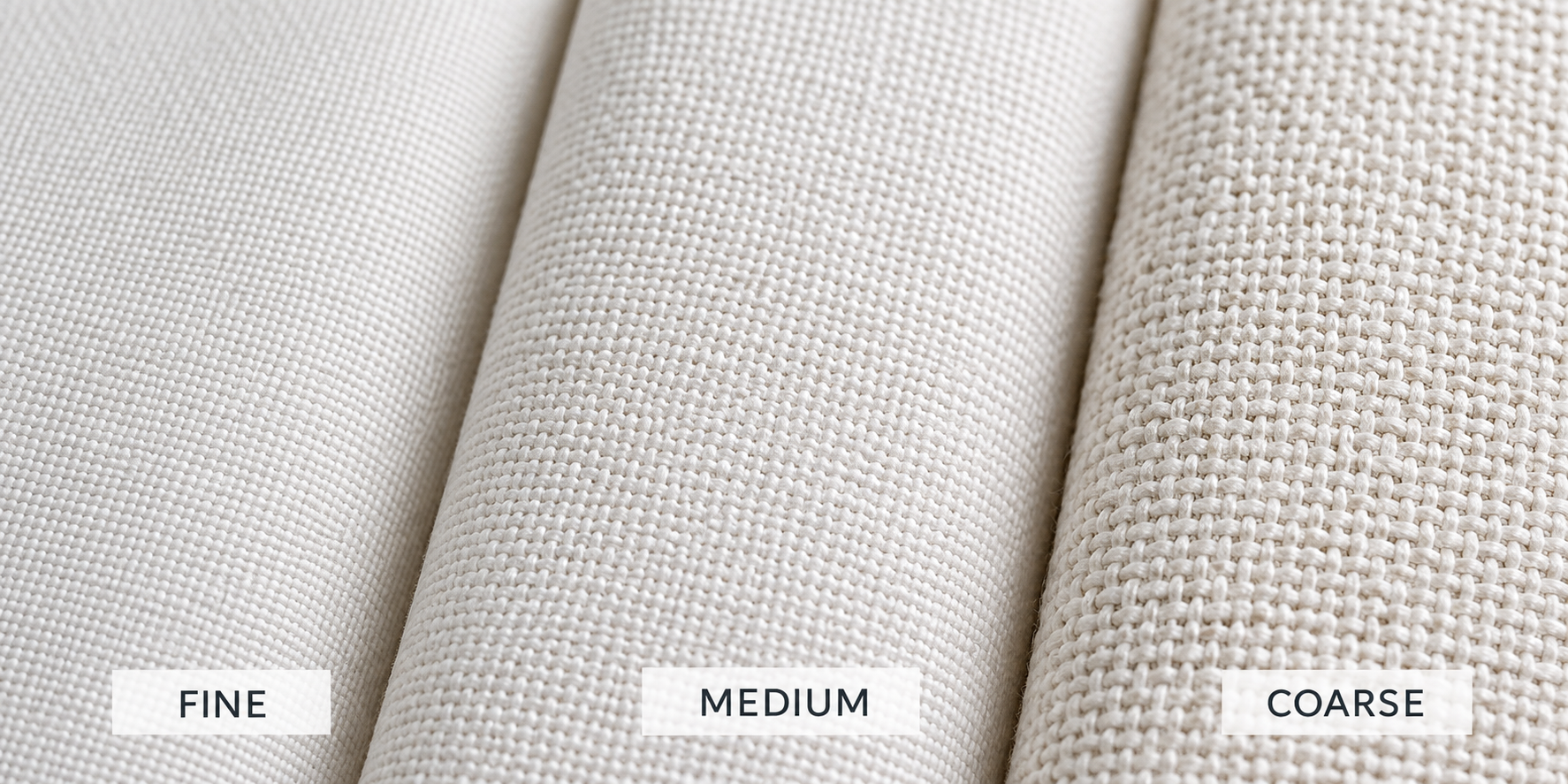
Fine, medium and coarse grain describe the visible and tactile character of an artist canvas surface. They are useful selection terms, but they are not universal measurements: one supplier’s medium grain may look or feel different from another supplier’s medium grain.
The final artist canvas texture comes from two connected parts: the base fabric and the prepared painting surface. Fiber type, yarn, weave and fabric construction establish the underlying structure, while priming, coating and surface finishing can preserve, soften or modify that structure. A grain label therefore should not be approved in isolation. For wholesale, private-label and repeat production, a physical sample and an agreed texture reference provide a clearer basis for comparison.
This guide concerns artist canvas rolls for painting. Artist canvas priming is developed around painting media and brush response; it should not be evaluated as if it were a digitally printable canvas coating.
What Does “Grain” Mean in Artist Canvas?
Grain describes the perceived topography of the painting surface: how smooth, moderate or pronounced the canvas looks and feels. It can reflect the pattern of the woven threads, yarn size, thread density, small variations in the fabric and the way the prepared surface covers or follows the weave.
Weave and final surface texture are related, but they are not identical. Weave describes how the warp and weft yarns are interlaced in the fabric. Final texture describes the surface presented to the paint after sizing, priming, coating and finishing. A clearly visible weave may remain prominent after preparation, while another priming system may fill or soften part of the same underlying fabric structure. It should not be assumed that priming completely removes the weave in every canvas.
Fine vs Medium vs Coarse Grain Artist Canvas
| Grain | Typical Surface Character | Common Painting Considerations | Typical Applications |
|---|---|---|---|
| Fine | Smoother surface with a less pronounced woven character | Often considered when fine lines, small details or smoother transitions are important | Portraits, detailed figurative work, realism and fine brushwork |
| Medium | Visible but moderate canvas texture | Balances surface character with the ability to develop detail | General oil and acrylic ranges, studio work and versatile retail assortments |
| Coarse | More pronounced grain and visible woven structure | Can make the canvas texture a more active part of the painted image | Expressive brushwork, heavier paint application and selected larger-format work |
These are practical descriptions rather than fixed quality grades. Fine grain is not automatically better than coarse grain, and coarse grain is not automatically stronger. The appropriate surface depends on the intended painting technique and the finished artwork.
What Creates Fine, Medium or Coarse Canvas Texture?
Yarn Thickness and Yarn Structure
Thicker yarns may create a more visible structure, while finer yarns can support a smoother-looking weave. That relationship is not absolute because yarn twist, uniformity, spacing and the complete fabric construction also affect the result.
Weave and Thread Density
The interlacing pattern and the number and spacing of yarns influence how strongly the weave reads through the finished surface. A tighter construction can appear different from a more open construction even when both fabrics use a similar fiber.
Fiber and Fabric Construction
Cotton, linen, poly-cotton and other fibers have different natural characteristics, but fiber name alone does not define grain. Yarn selection and weaving can produce multiple textures within the same material family.
Fabric Weight
GSM contributes to the overall canvas specification, but the same mass can be reached through different combinations of yarn and construction. Weight cannot identify the final grain by itself.
Priming, Coating and Surface Finishing
The prepared surface may follow the weave closely, cover it more fully or create additional tooth. Formulation, application, coverage, drying and finishing all contribute. Different manufacturers can therefore produce a similar perceived grain through different combinations of fabric and surface preparation.
Does Canvas GSM Determine Surface Texture?
No. GSM measures mass per unit area. It does not directly specify yarn thickness, weave pattern, thread density, final grain or priming smoothness.
Two artist canvas rolls with a similar GSM can have different weaves and noticeably different painting surfaces. A heavier canvas is not automatically coarse, and a lighter canvas is not automatically fine. GSM remains useful for comparing product specifications, but it should be assessed together with fiber composition, construction, priming, texture and the intended finished format.
How Does Priming or Coating Change Artist Canvas Texture?
The base fabric provides the underlying woven structure, while the prepared painting surface modifies how that structure is presented to the artist. Depending on the artist-canvas system, sizing, priming, ground or other surface-preparation steps may serve different functions. The final prepared surface can influence smoothness, the prominence of the weave, absorbency, tooth and the way a brush or paint interacts with the canvas.
Additional or heavier surface preparation may fill some low areas in the weave and produce a smoother result. A lighter preparation may leave more fabric character visible. Neither approach is automatically better, and more primer or more coating passes do not by themselves prove a better artist canvas. The prepared surface must be considered together with the painting medium, desired texture and flexibility required during converting or stretching.
What Is Canvas “Tooth” and Is It the Same as Grain?
Grain and tooth are connected, but they are not perfectly interchangeable. Grain mainly describes the visible and tactile surface structure. Tooth commonly describes the drag or grip felt as a brush, drawing tool or paint moves over that surface.
Two samples can look similar yet feel different during painting because primer formulation, absorbency and finishing influence surface interaction. For that reason, visual inspection alone cannot fully confirm tooth. Applying the intended paint to a sample gives a more useful reference.
Fine Grain Canvas: When Is It a Good Choice?
Fine grain canvas may be preferred when the artwork relies on small details, controlled edges, delicate lines or smoother tonal transitions. Portrait work, detailed figurative painting and realism often use smoother surfaces because a pronounced weave can become visually active within subtle passages.
This remains a matter of technique and preference rather than a fixed rule. Some portrait painters deliberately retain visible canvas character, while some abstract painters use very smooth grounds. A very smooth surface may also reduce the woven appearance that other artists want to remain part of the finished artwork.
Medium Grain Canvas: Why Is It So Versatile?
Medium grain retains a recognizable canvas character without making the weave dominant in every painted area. It can support detailed passages as well as broader brushwork, making it a practical general-purpose surface for many oil and acrylic approaches.
For a wholesale or private-label assortment, medium grain can provide a useful central specification between smoother and more pronounced surfaces. That does not make every medium grain interchangeable. The physical sample, priming and actual painting response still need to match the approved product.
Coarse Grain Canvas: When Does Strong Texture Help?
Coarse grain gives the woven structure a stronger visual and tactile presence. It may suit expressive brushwork, heavier paint application and artwork in which surface texture is intended to contribute to the image. The texture can remain visible through thinner areas of paint or interact with broader marks.
Coarse grain should not be treated as a synonym for heavy or strong canvas. Strength and stretching behavior depend on the yarn, weave, fiber, fabric construction and complete prepared product. Format and technique should be tested rather than inferred from the grain name.
Does Cotton, Linen or Poly-Cotton Determine the Grain?
No. Fiber material and surface grain are separate parts of the specification. Cotton artist canvas can be woven and prepared in different textures. Linen artist canvas also appears in multiple yarns, weaves and surface preparations, so linen should not automatically be classified as fine grain. Poly-cotton artist canvas can likewise be developed with different fabric and surface specifications.
Material, construction, texture, priming and intended application should therefore be reviewed as one system. A material name cannot replace an approved surface sample.
Oil vs Acrylic: Should the Canvas Texture Be Different?
Neither oil nor acrylic requires one universal grain. Both can be used across fine, medium and coarse surfaces when the canvas preparation is appropriate for the intended medium. Texture selection is usually driven by brushwork, detail level, paint application, desired visual effect and artist preference.
The priming requirement still matters. A surface prepared for a particular painting medium should be confirmed as part of the product specification. Avoid assuming that a texture label alone establishes oil or acrylic compatibility.
How Should B2B Buyers Specify Artist Canvas Texture?
Writing only “medium grain” on a purchase specification may leave room for interpretation. A clearer artist canvas specification combines:
- Material composition
- GSM
- Weave or fabric construction where available
- Required roll width
- Primed or unprimed condition
- Priming or coating type where confirmed
- Surface finish and intended painting medium
- Fine, medium or coarse texture description
- An approved physical sample or agreed visual and tactile reference
A retained approval sample is especially useful because grain terms can vary between suppliers. It gives purchasing, production and quality teams a shared reference for repeat orders without relying on wording alone.
How Should You Compare Artist Canvas Texture Samples?
- Compare all samples under the same lighting.
- Use the same viewing distance and angle.
- Inspect the blank surface and the underlying weave.
- Feel each surface consistently where tactile comparison is appropriate.
- Apply the intended oil, acrylic or other approved painting medium.
- Test both fine lines and broad brushwork.
- Observe how much weave remains visible through the paint.
- Compare surface drag or tooth during application.
- Use the intended painting technique and finished format.
- Retain the approved sample as the production reference.
Testing should use comparable paint, tools and application conditions. Otherwise, differences in technique can be mistaken for differences in the canvas.
What Should You Ask an Artist Canvas Supplier?
- What is the fiber composition?
- What is the nominal GSM?
- How is the surface grain classified?
- Is a physical texture sample available?
- Is the canvas primed or unprimed?
- What painting medium is the prepared surface intended for?
- What roll widths are available?
- Can the approved surface specification be maintained for repeat orders?
- How will a material or process change affecting the approved surface be handled?
Frequently Asked Questions
Is fine grain canvas always smoother?
Fine grain normally indicates a smoother-looking and less pronounced texture, but the final feel also depends on priming, coating and finishing. Samples from different suppliers should be compared directly.
Is coarse canvas heavier than fine canvas?
Not necessarily. GSM and grain describe different properties. GSM measures mass per unit area, while grain describes the character of the painting surface. Different combinations of yarn, weave, fabric construction and surface preparation can produce different textures at similar weights, so grain should not be inferred from GSM alone.
Is linen canvas always fine grain?
No. Linen can be made in fine, medium or coarser constructions. The fiber name alone does not establish the final texture.
Does more priming make artist canvas better?
No. Priming changes coverage, absorbency, tooth and the visibility of the weave, but a greater amount is not automatically better. The prepared surface needs to match the intended painting medium and surface specification.
Which canvas texture is best for portraits?
Fine grain is often preferred for portraits that require delicate detail and smooth transitions, but it is not mandatory. The appropriate grain depends on the painter’s technique and desired surface character.
Can the same texture be used for oil and acrylic painting?
Yes, the same grain category can be used for either medium when the canvas preparation is suitable. Texture and painting-medium compatibility should be confirmed separately.
Request an Artist Canvas Sample from Gowin
When requesting an artist canvas sample, provide the preferred material, GSM, roll width, grain or texture, priming requirement, intended painting medium, estimated quantity and destination. Where surface texture is important, compare and retain an approved physical sample before confirming bulk production.