
Matte vs Glossy Canvas: How to Choose the Right Surface Finish for Your Printing Application
After you have selected the right canvas base material and ink compatibility, surface finish becomes one of the most important decisions in the specification. It changes how the finished image responds to light, how strong the colours appear, how much texture the viewer notices and how the product feels when handled. Two canvas rolls can use the same fibre composition, weave and GSM yet create noticeably different results because their coating and surface finish are different.
There is no finish that is best for every print. Matte supports easy viewing and a traditional presentation. Glossy gives photographs and commercial graphics stronger visual impact. Satin, also commonly described as semi-gloss or semi-matt, balances colour presence and reflection. The right choice depends on the image, lighting, printing system, finishing method and product position.
For coated printable canvas, finish is part of the ink-receptive system rather than decoration added at the end. The coating influences ink control, drying or curing, colour, durability and flexibility. A surface can look attractive before printing but still fail under the intended lighting or during gallery wrapping.
This guide focuses on printable canvas rather than unprinted artist canvas. If you are still choosing the underlying fibre, first compare Cotton vs Poly-Cotton vs Polyester Printable Canvas. If printer and ink technology have not yet been confirmed, see How to Choose the Right Printable Canvas Roll for Different Printing Systems before approving the finish.
Why Canvas Surface Finish Matters in Professional Printing
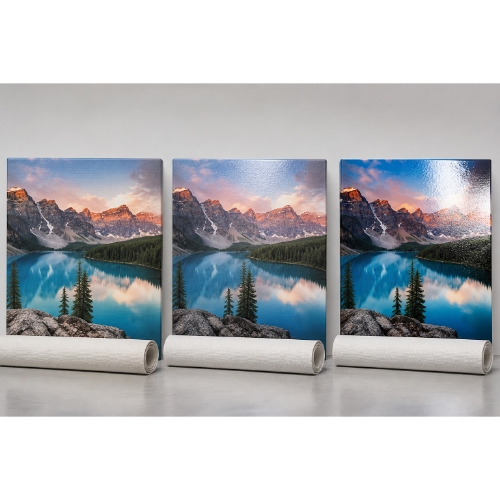
Surface finish determines how light leaves the printed canvas. Matte scatters more light and reduces sharp reflections. Gloss produces more directional reflection, which can make dark areas and saturated colours appear deeper under suitable lighting. Satin sits between these behaviours. The result affects product photography, retail display and the final wall installation.
Viewing Experience and Reflection
Reflection becomes a problem when a window or spotlight appears on the print and hides detail from the normal viewing position. Matte is easier to view from several angles. Gloss can look dimensional in controlled light, but placement requires more attention, especially on large hospitality, retail or corporate installations.
Colour Perception and Image Depth
Gloss often creates a stronger perception of saturation, contrast and black depth, while matte can appear softer. This does not make matte inaccurate or give gloss an automatically wider gamut. Colour performance also depends on coating, ink limit, printer, ICC profile and evaluation light. Profile the exact media rather than compensating for matte with excessive ink or saturation.
Texture and Touch
Finish changes how strongly the woven structure is perceived. Matte supports a natural impression; gloss makes colour and surface depth more obvious but may compete with a pronounced weave. Satin often retains visible texture while adding controlled colour lift. Handling should still be tested because some glossy coatings reveal fingerprints or packing marks more readily.
Product Positioning
Finish communicates product position. Matte commonly supports fine art and interior decor; gloss strengthens photo and retail ranges; satin suits broad private label collections. None is automatically more premium. Value comes from the complete print, finishing performance and repeat-order consistency.
Matte Canvas for Artistic and Interior Applications
Matte printable canvas has a low-sheen surface designed to minimise strong specular reflection. It gives the image a softer and more natural appearance, allowing the weave and artwork to remain visible under a wider range of lighting conditions. This is why matte canvas is common in fine art reproduction, gallery wraps, portraits, museum-style prints and residential or hospitality wall decor.
Where Matte Canvas Performs Well
- Fine art reproductions where a traditional canvas appearance supports the original artwork
- Gallery wraps displayed without glass in rooms with windows or mixed lighting
- Museum-style, corporate and hospitality artwork intended for comfortable long-term viewing
- Portraits, black-and-white images and muted colour palettes where restrained reflection is desirable
- Interior wall decor sold to customers who prefer a natural rather than photographic surface
Matte is particularly useful when you cannot control the final installation. Online wall decor may be hung opposite a window, under ceiling lights or in a narrow hallway. A low-reflection surface reduces the risk that glare becomes the first thing the customer notices.
Strengths of a Matte Finish
The main advantage is viewing flexibility. Image detail remains visible across more angles, and the surface is less likely to mirror nearby objects. Matte also tends to integrate well with the woven character of cotton and poly-cotton canvas, although polyester can be made with an effective matte surface as well.
A professional matte coating can still deliver strong colour, clean detail and good black density. The correct ICC profile and ink limit are important. If a print appears flat, first check colour management and coating performance instead of assuming that every matte canvas must look weak.
When Matte May Not Create Enough Impact
Some products are sold through vivid online photography, brightly lit retail spaces or fast visual comparison. A very low-sheen surface may not create the desired sense of depth for saturated travel photography, commercial graphics or highly polished decorative products. Matte can also reduce the visible contrast between the deepest blacks and bright highlights under certain lighting.
The decision should therefore be based on a printed sample viewed in the target environment. If matte feels too restrained but gloss creates too much reflection, satin is often the more practical direction.
Glossy Canvas When Contrast and Colour Impact Matter
Glossy printable canvas uses a more reflective coating to create stronger visual depth and colour presence. It is frequently selected for photo canvas, colourful decorative prints, retail displays and applications where the image needs to attract attention quickly. A well-controlled gloss surface can make saturated colours, highlights and dark tones appear richer.
Where Glossy Canvas Performs Well
- Photo canvas with vivid landscapes, travel images, food photography or highly saturated artwork
- Commercial displays and promotional graphics viewed in controlled or directional lighting
- Decorative products positioned around colour impact and a contemporary surface
- Retail and event applications where the image must compete with surrounding visual information
- Product ranges where a polished photographic effect is part of the customer expectation
Gloss does not automatically make a print more accurate. It changes perception. The same file may appear darker, more saturated or more contrast-rich than on matte canvas. Proofing should therefore use the exact glossy media and the lighting under which the product will be approved.
Strengths of a Glossy Finish
Gloss can increase perceived black depth and make colour transitions look more luminous. Fine photographic details may appear crisp when the coating, weave and printer settings are well matched. This surface can also create an immediate premium impression for products that are expected to look polished rather than traditional.
For commercial applications, stronger visual impact can be valuable at normal viewing distance. A retail display or seasonal decorative print may need to catch attention before the viewer approaches closely. Gloss or higher satin can help, provided reflections are controlled.
Lighting and Handling Considerations
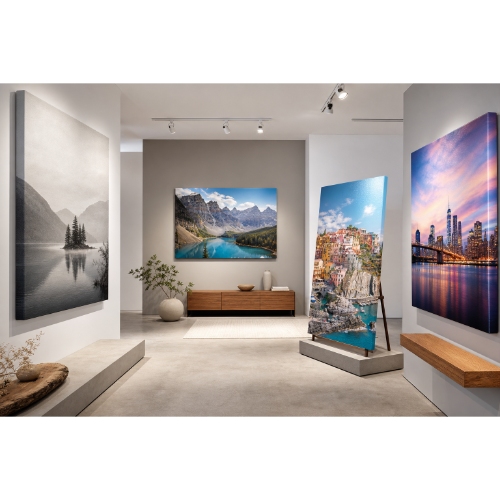
The strongest consideration is glare. Direct window light, track lights and bright ceiling fixtures can create reflections that hide parts of the image. A glossy print may look excellent from one position and difficult to view from another. This is why the installation plan matters as much as the artwork.
Surface handling also deserves attention. Depending on the coating, gloss can show fingerprints, abrasion, pressure marks or variation in post-print varnish more visibly. Test winding, cutting, stretching, interleaving and carton protection. If a protective liquid coating will be applied after printing, confirm that it produces a uniform sheen and remains flexible at the edges.
Satin, Semi-Gloss and Semi-Matt as the Middle Option
In the printable canvas industry, satin, semi-gloss and semi-matt are often used for a similar middle-sheen range. They describe a surface with more colour lift than matte and less reflection than full gloss. The terms are not governed by one universal visual standard, so one supplier’s satin may look closer to another supplier’s semi-gloss. Approve the actual sample rather than relying only on the finish name.
Satin is often a practical choice for photo canvas, general wall decor, portraits and private label collections serving several customer groups. It gives colours a controlled sense of depth while keeping reflections manageable in typical indoor lighting. It can also help a distributor reduce the number of finishes carried when one versatile product must cover a broad image mix.
Satin should not be treated as an automatic compromise. In many applications it is the intended finish because it balances image impact, texture and viewing comfort. The correct gloss level still depends on the coating, image and installation.
Matte vs Glossy Canvas Comparison
| Surface Finish | Appearance | Reflection | Best Applications | What You Should Check |
|---|---|---|---|---|
| Matte | Natural, soft and understated; woven texture remains visible | Low | Fine art reproduction, gallery wraps, portraits, museum-style and interior wall decor | Whether colour and black density are strong enough for the image and market position |
| Glossy | Polished, vivid and contrast-rich; creates stronger perceived depth | High | Photo canvas, colourful decor, retail graphics and controlled-light commercial displays | Lighting angle, glare, handling marks, gloss uniformity and flexibility during stretching |
| Satin / Semi-Gloss / Semi-Matt | Balanced colour lift with moderate sheen | Medium | Photo reproduction, general wall decor, portraits and broad private label ranges | The actual gloss level, because naming varies between suppliers and coating systems |
The table is a selection guide, not a quality ranking. A matte canvas can produce vivid colour, and a glossy canvas can be used for fine art when the original has a polished surface. The better finish is the one that preserves the intended image, remains comfortable to view and performs through printing, finishing and delivery.
How to Choose the Right Canvas Finish for Your Business
Step 1: Identify the Final Application
Start with the finished product. Fine art usually begins with matte; photo canvas often uses gloss or satin; general wall decor commonly uses matte or satin. Commercial displays can use any finish when lighting and viewing distance are considered. A glossy landscape that works in a showroom may be difficult to view in a bright hotel lobby.
Step 2: Map the Viewing Environment
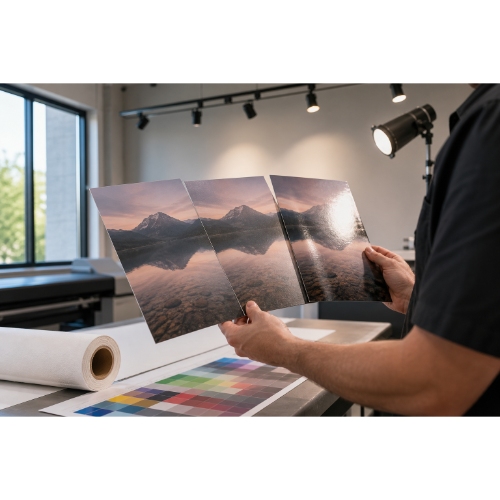
Record the main light sources and viewing angles. Retail spotlights, residential windows and rows of hospitality ceiling lights create different reflection risks. For an important project, compare matte, satin and glossy proofs in the actual space, or simulate its lighting and view each proof from several angles.
Step 3: Define Customer Expectations and Product Position
Define whether the product should feel artistic, photographic, understated or bold. The finish should agree with the packaging, online description and brand promise. For private label programs, decide whether one versatile satin product can reduce inventory, or whether specialist matte and glossy ranges justify separate stock and profiles.
Step 4: Confirm Printer, Ink and Coating Compatibility
Finish does not prove ink compatibility. A glossy eco-solvent canvas is not automatically suitable for an aqueous Epson SureColor or Canon imagePROGRAF printer, and matte aqueous media is not automatically ready for HP Latex, Roland, Mimaki or UV equipment. Confirm Water-Based Canvas Rolls, Eco-Solvent Canvas Rolls or UV & Latex Compatible Canvas Rolls before selecting sheen.
Step 5: Include the Finishing Process
Liquid laminate or varnish can shift matte toward satin, deepen gloss or create uneven sheen. UV ink can change gloss between printed and unprinted areas, while latex heat and eco-solvent drying conditions can alter media behaviour. Test the complete process, including stretching on Wooden Stretcher Bars, and inspect corners for whitening, cracking or gloss change.
Step 6: Approve With Representative Images
Test dark shadows, saturated colours, skin tones, gradients and uniform backgrounds. These reveal reflection, colour shifts and coating variation more clearly than one chart. Repeat testing when the printer, ink, profile, coating, varnish or production environment changes, and retain an approved master sample for repeat orders.
How Canvas Coating Technology Influences Print Performance
The coating layer receives the ink and creates the finish. Its formulation and application influence dot control, ink absorption or adhesion, drying, colour, durability and flexibility. Coating weight and uniformity also determine whether sheen remains consistent across the roll.
Water-Based Printing
Aqueous dye and pigment inks require an ink-receptive coating that controls liquid absorption and drying. Matte coatings are common for fine art and photo canvas, but gloss and satin aqueous products are also possible. The printer must be able to feed the canvas thickness, and the media setting and ICC profile should match the coating. Excessive ink can slow drying and weaken surface handling even when the base material is correct.
Eco-Solvent Printing
Eco-solvent coatings are designed to interact with solvent ink while maintaining colour, surface integrity and flexibility. Matte, satin and glossy results are possible. Drying conditions and ink load can change perceived sheen, especially in dark areas. Before bulk production, check colour, surface rub, odour or drying requirements, and stretching after the print has stabilised.
UV Printing
UV ink cures as a layer on the surface. The cured ink itself can change gloss and texture, so the final appearance may not match the unprinted media. This can be useful for visual impact, but gloss differential between printed and unprinted areas should be checked. If the canvas will be wrapped, confirm that the cured ink and coating remain flexible around edges and corners.
Latex Printing
Latex printing uses heat as part of ink drying and film formation. The canvas, coating and finish must tolerate the production temperature without distortion, surface change or loss of flexibility. A media profile should balance curing with colour and surface quality. Test the finish again after the print cools and before stretching or packing.
Coating Consistency Across Production
For repeat orders, check surface uniformity, gloss level, white point, coating adhesion, width and roll condition. Gloss can make variation more visible, while matte can still show banding or inconsistent absorption. OEM specifications should use an approved sample and practical tolerance, not only the words matte or gloss.
Common Mistakes When Choosing Canvas Finish
Choosing Only by the Unprinted Surface
The blank roll does not show the complete result. Ink coverage, colour, curing and protective coating can change sheen. Approve a printed and finished sample using representative images.
Ignoring the Lighting Environment
A glossy proof viewed on a desk may look impressive but reflect windows or spotlights after installation. Test from the expected viewing distance and angle. For uncontrolled lighting, matte or satin is usually a safer starting point.
Selecting Glossy for Every Colourful Image
Gloss can strengthen colour impact, but it can also create distracting reflections. A correctly profiled matte or satin canvas may deliver enough saturation with a better viewing experience. Choose by the complete application, not by colour intensity alone.
Treating Matte as Automatically More Accurate
Low reflection can make evaluation easier, but colour accuracy depends on the coating, printer, ink, profile and lighting. Matte, satin and glossy media each require their own proofing and colour-management approach.
Ignoring Ink Compatibility
Finish and ink technology are separate parts of the specification. Confirm the coating for aqueous, eco-solvent, UV or latex printing. Do not assume that the same matte or glossy canvas works on every printer.
Skipping the Stretching and Packing Test
Coating may crack, whiten or change gloss at folds. Glossy surfaces may also show rubbing or pressure marks during shipping. Print, finish, stretch and pack the sample as the final product will be produced.
Using Finish Names Without a Physical Standard
Satin, semi-gloss and semi-matt often overlap, and gloss levels vary by supplier. Keep an approved sample and record the coating, material, GSM, width and finishing process for repeat orders.
How Gowin Helps You Select the Right Canvas Finish
Gowin has manufactured canvas and wooden art supply products since 2005. When you are selecting a finish, we can review the printer and ink type, base material, final application, lighting, stretching process, target market and production volume before proposing a matte, satin or glossy sample direction.
The sample should be tested through the complete workflow. We suggest printing representative dark areas, saturated colours, skin tones and gradients, then checking the result after the required drying or curing time. If you apply varnish or liquid laminate, include it in the test. For gallery wraps, stretch the finished sample and inspect the corners and edges.
Gowin can discuss different coating solutions, surface finishes, widths, roll lengths and packing for OEM or private label production. Material and coating can also be developed to meet a defined application when the order volume supports customization. If a suitable standard item is in stock, a one-roll trial may sometimes be possible; custom coating and finish normally require volume and should be confirmed against the complete order.
Before bulk production, both sides should confirm the approved sample, material, GSM tolerance, coating system, finish, white point, width, length, core and packing. This provides a practical reference for repeat supply and reduces misunderstandings caused by finish names alone.
Frequently Asked Questions
Is matte canvas better than glossy canvas?
Neither finish is better for every application. Matte reduces glare and supports a natural art presentation. Glossy creates stronger perceived contrast and colour impact. Choose according to the image, lighting, printing system, customer expectation and finishing process.
Which canvas finish is best for photo printing?
Glossy or satin often works well for photographs that need vivid colour and visual depth. Matte can be better for portraits, black-and-white photography or installations with difficult lighting. Print the same representative image on the shortlisted finishes before approval.
Which canvas finish is best for wall decor?
Matte and satin are common because they remain comfortable to view in varied residential, hospitality and office lighting. Glossy can work for contemporary or highly colourful wall decor when reflections are controlled.
Is glossy canvas suitable for gallery wraps?
Yes, when the coating and printed ink layer remain flexible during stretching. Test the print after full drying or curing and inspect the edges and corners for cracking, whitening and gloss change.
Does surface finish affect colour accuracy?
Finish changes perceived colour, contrast and black depth. Accuracy also depends on the coating, ink, printer, ICC profile and evaluation light. Use a profile and proof made for the exact media rather than applying one setting to every finish.
Are satin, semi-gloss and semi-matt the same?
They are often used for a similar middle-sheen range, but the exact gloss level varies among suppliers and coating systems. Approve the physical sample and keep it as the repeat-order standard.
Can Gowin customize canvas coating and finish?
Yes. Depending on the application and supporting order volume, Gowin can discuss coating compatibility, matte, satin or glossy finish, base material, width, roll length and private label packing. Custom development should begin with the printer, ink, final use and approved sample standard.
When requesting samples, provide the printer model, ink type, base material, intended application, lighting environment, preferred finish, width and expected order volume. These details allow the sample selection to begin with the actual production requirement rather than a finish name alone.