
Cotton vs Poly-Cotton vs Polyester Printable Canvas: Which
Material Should You Choose?
Choosing a printable canvas material affects more than the look of one finished print. It influences colour reproduction, surface texture, stretching behaviour, production speed, waste, freight weight and the market position of the final product. A material that performs well for a limited-edition fine art reproduction may not be the most efficient choice for a wall decor factory printing hundreds of rolls each month. In the same way, a stable commercial polyester canvas is not automatically the right surface for a brand built around a traditional cotton feel.
There is no single best canvas material. The right choice depends on the final application, printer and ink system, coating, finishing process, order volume and the expectations of the customer who will buy the finished print. Cotton, poly-cotton and polyester can all produce professional results when the fabric construction and coating are matched to the job.
One distinction matters from the beginning: printable canvas is a coated printing medium. The base fabric creates the underlying structure, texture and dimensional behaviour, while the coating controls how the ink is received, held and dried. A 100% cotton base with the wrong coating will not outperform a properly coated polyester base. Conversely, a technically printable surface can still be unsuitable if it cracks during gallery wrapping or does not deliver the texture expected by the target market.
This guide compares the three main printable canvas materials from a production and sourcing perspective. For a separate explanation of printer technologies, see How to Choose the Right Printable Canvas Roll for Different Printing Systems. For unprinted, primed painting surfaces, refer to Artist Canvas Rolls rather than applying every conclusion in this guide to artist canvas.
Why Canvas Material Matters in Professional Production
When you source printable canvas by the roll, the specification must work throughout the production chain. The roll has to feed reliably, accept the intended ink, dry or cure within the available workflow, withstand handling, stretch around a frame if required and arrive at the end customer with the expected appearance. Material composition affects each stage, but it should never be reviewed in isolation from weave and coating.
Surface Feel and Visual Character
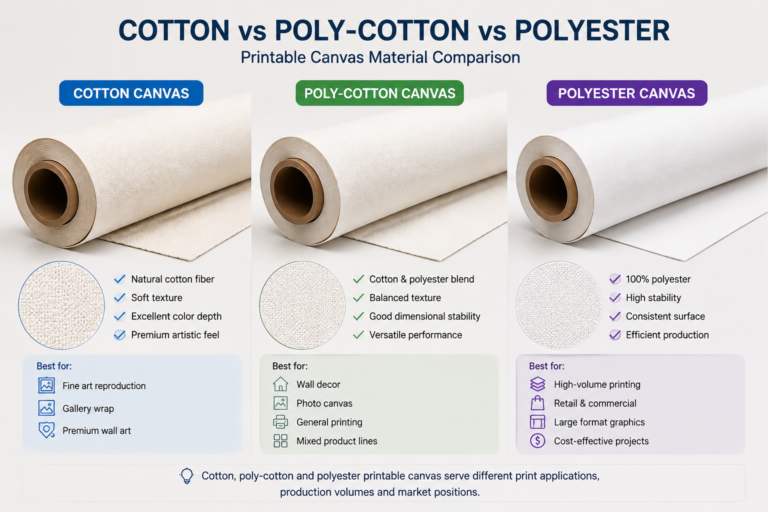
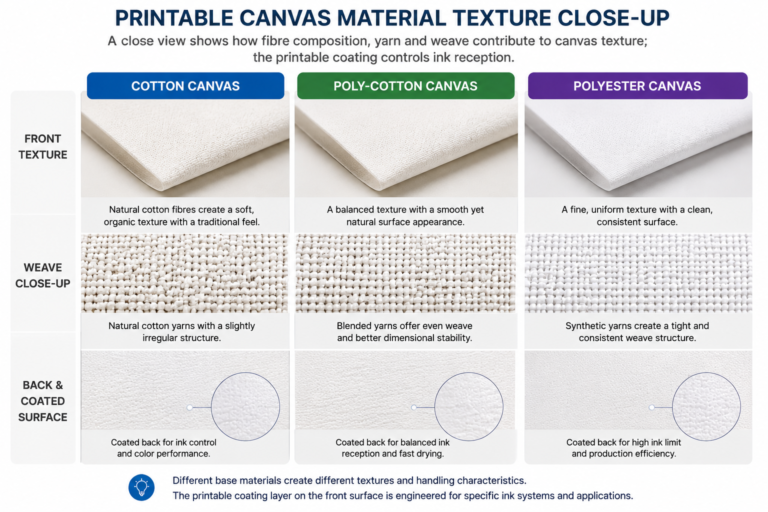
Cotton fibres naturally create a softer, more traditional character. Polyester yarns can produce a tighter and more uniform structure. Poly-cotton sits between them, although the result changes with the blend ratio, yarn size and weave. A pronounced texture can support reproductions of paintings and decorative artwork, while a smoother surface may hold fine photographic detail more clearly. Neither direction is inherently better; it must match the image style and product positioning.
Ink Reception and Colour Appearance
On printable canvas, most ink interacts first with the receptive coating rather than directly with the fibre. The coating formulation influences ink limit, dot control, colour gamut, drying and water resistance. The base material still matters because it affects surface uniformity, whiteness, tension and how the coating sits on the weave. This is why two canvases with the same fibre percentage can print very differently.
Colour should be evaluated on the actual printer, ink set and RIP or ICC workflow. Epson SureColor and Canon imagePROGRAF aqueous printers, HP Latex equipment, and Roland or Mimaki eco-solvent and UV systems do not place identical demands on media. A label such as ‘cotton canvas’ does not prove compatibility with any of them. The product must carry the appropriate water-based, eco-solvent, UV or latex coating.
Dimensional Stability and Stretching
Dimensional stability affects tracking through the printer, edge alignment, roll handling and the shape of a finished gallery wrap. Cotton responds more noticeably to moisture and environmental changes. Polyester is usually more dimensionally stable. A well-engineered poly-cotton blend provides some natural character while reducing variation. For stretched products, however, stability alone is not enough. The printed and coated canvas also needs suitable flexibility, fold resistance and crack resistance at edges and corners.
Cost Structure and Production Yield
The material price per square metre is only one cost. Production yield also depends on loading, head-strike risk, drying time, reprints, stretching losses and consistency between rolls. A premium cotton canvas may be financially correct for limited editions with a higher selling price. Polyester can be the stronger commercial choice when repeatability and throughput drive profit. Poly-cotton is often selected when a product line needs a textured appearance without giving up too much stability or cost control.
Cotton Printable Canvas: Premium Character for Artistic Printing
Cotton printable canvas uses a natural fibre base coated for a defined ink system. It is commonly associated with fine art reproduction because the weave and hand feel can support a traditional visual language. When a customer handles the edge or views the print at close range, the material can reinforce the impression of a premium art product.
Where Cotton Performs Well
- Fine art and giclee reproductions where natural texture is part of the value proposition
- Premium gallery wraps sold through galleries, photographers or specialist wall art brands
- Museum-style and limited-edition presentation where surface character matters more than maximum throughput
- Black-and-white or painterly images that benefit from visible woven depth
For aqueous pigment and dye printing, Water-Based Canvas Rolls can be produced with cotton bases when the coating, thickness and printer feed path are suitable. Before approving a bulk order, confirm the exact printer model and whether it is designed for thick media. Some aqueous printers accept canvas through a dedicated rear or manual feed, while others are intended mainly for thinner photo paper.
Why You May Choose Cotton
Cotton is a strong choice when the material story is visible in the selling price. It can give reproductions a natural appearance and a deeper tactile quality than a very uniform synthetic weave. It also helps a premium brand communicate that the print is made on a traditional fibre rather than a generic display fabric.
What Requires More Control
Natural fibre is not a defect, but it behaves less uniformly than a synthetic fibre. Moisture, storage, tension and batch variation require attention. During production, roll edges, fabric tension, surface consistency and coating uniformity should be checked. When the canvas will be stretched, the sample should be printed, fully dried, folded around the intended stretcher profile and inspected for whitening, coating fracture or corner cracking.
Cotton also tends to carry a higher material cost and may not provide a commercial advantage when the finished print is sold mainly on image and price. If the customer cannot see or value the natural texture, using cotton may increase cost without improving the product’s position.
Poly-Cotton Printable Canvas: Balanced Texture and Stability
Poly-cotton canvas combines cotton and polyester fibres in the base fabric. The goal is not simply to create a cheaper version of cotton. A well-designed blend can preserve a natural-looking texture while improving dimensional stability, roll consistency and production handling. The exact result depends on the blend ratio and fabric construction, so the term poly-cotton alone is not a complete specification.
Where Poly-Cotton Fits Best
- Photo canvas and gallery wrap programs that need texture, dependable stretching and repeat production
- Wall decor collections serving both premium and mainstream retail channels
- Private label ranges that need a balanced material story and controlled target cost
- Print factories producing varied artwork rather than one narrow image category
Poly-cotton is useful when you want one material direction to cover several applications. The cotton content supports a more traditional surface, while polyester contributes structural stability. This can reduce the gap between a premium fine art canvas and a purely commercial decor canvas.
Why Blend Ratio and Weave Matter
Two poly-cotton canvases can behave differently even at the same GSM. A higher cotton share can increase natural feel but may also increase environmental response. A higher polyester share can improve stability and uniformity. Yarn count, thread density and weave pattern change surface depth, strength and coating holdout. For this reason, a request for ‘poly-cotton, 380gsm’ is not enough to reproduce an approved sample. The material specification should also identify the blend, construction, coating, finish and tolerance.
Poly-cotton can be supplied for aqueous printing and, with the correct formulation, for eco-solvent, UV or latex production. Never assume that a poly-cotton base automatically works across all systems. Eco-Solvent Canvas Rolls and UV & Latex Compatible Canvas Rolls should be selected by confirmed coating compatibility and tested under the intended curing or heating conditions.
Polyester Printable Canvas: Consistency for Commercial Production
Polyester printable canvas uses a synthetic fibre base with a stable and repeatable structure. It can be woven with a smooth surface for photographic detail or with a more visible canvas pattern for wall decor. Describing polyester as low quality misses the reason many professional print operations use it: it can support predictable feeding, controlled stretching, efficient handling and consistent results over repeat orders.
Where Polyester Performs Well
- High-volume wall decor and photo canvas production
- Commercial interior graphics, retail displays and hospitality projects
- Wide-format printing where roll stability and repeatability are important
- Price-sensitive product lines that still require a controlled surface and professional print result
Polyester is widely available with coatings for aqueous, eco-solvent, UV and latex systems. This does not mean one polyester roll is universal. Aqueous coatings are designed to manage water-based pigment or dye inks. Eco-solvent coatings respond to solvent ink chemistry. Latex media must tolerate the printer’s heat and curing process, while UV applications need an ink layer and surface that remain flexible if the canvas will be wrapped around a frame.
Why Polyester Supports Production Efficiency
A stable synthetic base can reduce unwanted stretch or shrink during printing and finishing. Uniform yarn and weave also make it easier to hold a consistent surface from roll to roll. In a high-volume operation, these characteristics can improve loading, alignment, cutting and stretching. A lighter polyester construction may also reduce roll weight and freight cost, provided it still has enough body for the final application.
When Polyester Can Be a Premium Choice
Polyester is not restricted to entry-level products. A high-quality coating, controlled weave, neutral white point and strong crack resistance can support premium photographic and decorative prints. It may be the better choice when fine detail, bright commercial colour, environmental stability or repeatability matters more than a natural-fibre story. The finished product should be judged by the total construction and performance, not by fibre name alone.
Cotton vs Poly-Cotton vs Polyester Printable Canvas Comparison
Material | Texture | Stability | Best Applications | Production Volume | Cost Position |
Cotton | Natural, deeper woven character; exact feel depends on weave and coating | Moderate; more responsive to humidity and tension | Premium fine art reproduction, museum-style prints, high-end gallery wraps | Low to medium, or premium controlled production | Premium |
Poly-cotton | Natural-looking texture with a more controlled structure | High; generally easier to keep consistent than pure cotton | Photo canvas, wall decor, private label ranges, mixed product programs | Medium to high | Mid to premium |
Polyester | Uniform; can be smooth or visibly textured depending on yarn and weave | Very high; predictable roll handling and dimensional behavior | Commercial wall decor, retail graphics, wide-format and repeat-volume production | High | Value to premium, depending on coating and construction |
The table describes common directions, not fixed rules. Cotton can be used in repeat production, and polyester can be used for premium art. The decision changes with coating quality, weave, GSM, finish, printer, image type and market expectations. A sample made under the actual production conditions is more reliable than a material label or price list description.
How to Choose the Right Printable Canvas Material for Your Business
Step 1: Start With the Final Application
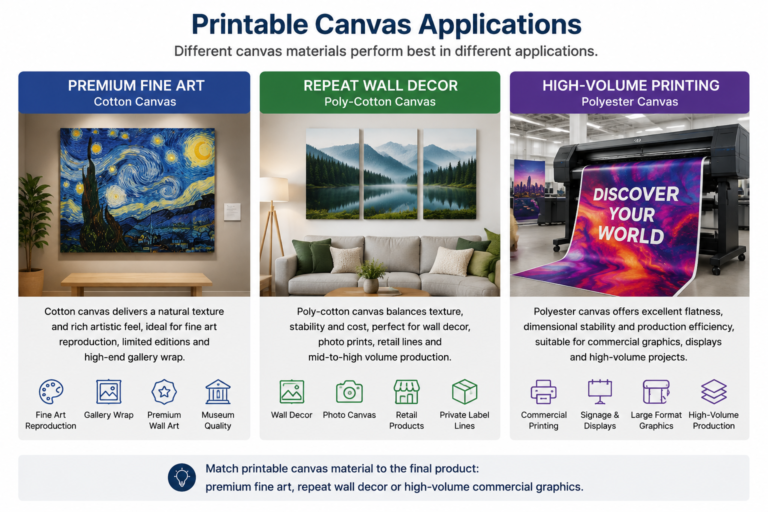
Identify what you are producing before comparing roll prices. For premium fine art reproduction, cotton is often the first material to test because natural texture supports the product story. For wall decor and photo canvas, poly-cotton or polyester may offer a better balance of visual character, stretching and repeatability. For high-volume commercial printing, polyester is usually the most efficient starting point. These are starting directions, not automatic approvals.
Step 2: Define the Market Position
Ask what the customer is paying for. A gallery edition may justify cotton because fibre and texture contribute to perceived value. A private label wall decor range may need poly-cotton to balance appearance and margin. A retailer replacing seasonal collections quickly may benefit more from a stable polyester canvas with efficient production. Selecting a premium material when the market does not value it can weaken the cost structure without creating a stronger product.
Step 3: Match the Printer, Ink and Coating
Confirm the printer model, ink type and curing method. Epson SureColor and Canon imagePROGRAF aqueous printers typically require coated media for pigment or dye ink and may have specific thickness limits. Roland and Mimaki equipment may use eco-solvent, UV or other ink configurations. HP Latex production introduces heat and curing considerations. Choose the material only after the coating is confirmed for that system.
Request the supplier’s ink compatibility, but test it on your own machine. Printer condition, ink batch, RIP settings, ICC profile, pass count, ink limit, room humidity and drying environment can all change the result. When you change printer models, inks, coating or production location, repeat the sample test rather than assuming the previous profile will transfer perfectly.
Step 4: Check the Finishing Process
If the canvas will be stretched, test the full finishing sequence. Print the image, allow the specified drying or curing time, apply any protective coating used in production, then stretch it over the intended Wooden Stretcher Bars. Check the face, edges and corners under normal lighting. Good print quality is not enough if the coating cracks, the image turns white at the fold, or the material cannot hold stable tension.
For products mounted flat rather than stretched, surface uniformity, curl, cutting and adhesive compatibility may matter more. For banners or temporary displays, tear resistance and finishing at eyelets or sewn edges can become the deciding factors. The same base material can therefore be right for one finishing route and wrong for another.
Step 5: Calculate Production Cost, Not Only Material Cost
Compare usable output per roll. Include waste at loading, test strips, rejected prints, drying space, labour, reprints and packing weight. A lower-priced material that produces frequent head strikes or corner cracks can be more expensive than a higher-priced roll with stable yield. Conversely, a premium cotton canvas may be unnecessary for a fast-moving commercial decor line. The most profitable material is the one that meets the product promise with controlled total cost.
Step 6: Approve a Repeatable Specification
After sampling, document the approved composition, blend ratio if applicable, yarn and weave direction, GSM tolerance, coating, finish, white point, width, roll length, core, packing and test result. For ongoing programs, retain an approved sample or master swatch. This gives both sides a practical reference for repeat orders and reduces decisions based on memory or photography alone.
Common Mistakes When Selecting Printable Canvas Material
Choosing by Price Alone
Price per roll does not show production yield or product value. Compare coating performance, consistency, waste, finishing and the selling position of the final print. A suitable commercial polyester canvas can outperform a poorly matched cotton canvas, while a premium cotton surface can justify its cost in the right market.
Assuming Higher GSM Means Better Quality
GSM describes weight, not coating quality, weave accuracy, colour gamut or crack resistance. A lighter polyester canvas may be stable and efficient for commercial production. A heavier cotton or poly-cotton canvas may provide more body for gallery wrapping. Select weight after you know the application, printer feed limit and frame structure.
Ignoring Coating and Ink Compatibility
Fibre composition does not identify the ink system. A cotton base coated for aqueous ink is not automatically suitable for eco-solvent or latex printing. Confirm whether the media is designed for water-based, eco-solvent, UV or latex ink and whether the intended printer can handle its thickness and curing requirements.
Selecting Premium Material Without a Market Reason
A premium specification should solve a visible requirement: natural texture, limited-edition positioning, heavier hand or a particular archival program. If the final customer mainly values price, image and fast delivery, a stable poly-cotton or polyester construction may create a stronger commercial offer.
Approving the Print but Not the Finished Product
A flat print can look excellent and still fail during stretching, coating, cutting or packing. Test the complete process. Inspect edges and corners, allow realistic drying time and pack the sample as it will be shipped. This is especially important when changing coating, varnish, stretcher profile or production environment.
Ignoring Repeat-Order Consistency
A first sample is only the beginning. For a repeat program, define tolerances and confirm that the manufacturer can control fabric, coating, width and packing across batches. Cotton may show more natural variation, while polyester may be more uniform, but every material still needs production control.
How Gowin Helps You Select Printable Canvas Materials
Gowin has produced canvas and wooden art supply products since 2005. When you send an enquiry, we can review the application, printer and ink type, required width, finish, stretching process, target price and order volume before proposing a material direction. This is more reliable than recommending cotton, poly-cotton or polyester from GSM alone.
During sample evaluation, we suggest printing representative dark areas, skin tones, gradients and fine details rather than using only a colour chart. After the print has dried or cured, check colour, surface, rubbing, folding and stretching. Different printers, ICC profiles and drying environments can produce different results, so sample testing should be repeated when you change printer models, inks or coatings.
Standard Printable Canvas Rolls may be available in common widths and specifications. When a suitable item is in stock, a one-roll trial can sometimes be arranged. Custom width, coating, material, weave, recycled polyester content, core, packing or private label presentation normally requires order volume to support production. MOQ should therefore be confirmed against the complete order rather than treated as one fixed number for every specification.
For OEM and private label programs, we can work from your approved sample or target specification. Before bulk production, both sides should confirm the material construction, coating, finish, width, length, packing and test standard. This creates a clearer basis for repeat orders and international shipping.
Frequently Asked Questions
Is cotton canvas better than polyester canvas?
Not in every application. Cotton is often preferred when natural texture and premium fine art positioning are important. Polyester is often stronger for dimensional stability, repeatability and high-volume production. Coating, weave and finishing performance can matter as much as fibre composition.
What is the difference between poly-cotton and cotton printable canvas?
Cotton uses a natural fibre base, while poly-cotton combines cotton and polyester. Poly-cotton usually offers more dimensional stability and repeatable handling while retaining some natural texture. The actual difference depends on the blend ratio, yarn, weave and coating.
Which printable canvas material is best for wall decor?
Poly-cotton and polyester are common starting points. Poly-cotton suits wall decor that needs a textured, more natural appearance. Polyester suits repeat-volume programs that prioritise consistency, efficient handling and controlled cost. Cotton can be appropriate for premium wall art where the material story supports a higher selling price.
Which canvas is better for high-volume production?
Polyester is generally the first material to test because its structure is stable and consistent. A well-engineered poly-cotton can also work well when you need more natural texture. Final approval should be based on printer feeding, drying or curing, colour, waste and finishing tests.
Does GSM matter more than canvas material?
No. GSM describes weight only. Material, weave, coating, printer compatibility, crack resistance and final application should be evaluated together. A heavier roll is not automatically a better printable canvas.
Can the same canvas be used with aqueous, eco-solvent, UV and latex printers?
Only when the manufacturer has designed and tested the coating for those systems. Do not assume compatibility from the base fabric. Confirm the ink technology and test the media on the intended printer, especially when heat, curing or stretching is involved.
Can Gowin provide customized printable canvas materials?
Yes. Depending on project volume, we can discuss custom cotton or poly-cotton constructions, polyester and recycled polyester options, coatings, widths, finishes, roll lengths and packing. Custom development begins with the application and sample standard, and MOQ depends on the complete specification and order.
If you are comparing materials for a new printable canvas program, send the printer model, ink type, final application, preferred texture, width, finish, expected monthly volume and target market. These details make it possible to select a practical sample direction before bulk production.