
Long-Length vs Miter-Cut vs Tenoned Stretcher Bars: Which Supply Format Fits Your Production?
Two companies can use the same pine stretcher-bar profile and still need different supply formats. A canvas factory with saws and joining equipment may prefer long moulding cut against daily orders. A print shop may want exact-size parts shipped flat. A company with limited woodworking capacity may compare pre-assembled frames with their extra cubic volume. An art-supply distributor may need standardized tenoned sets for simple downstream assembly.
The decision is therefore larger than the corner shape. You are deciding where the value-added work should happen: at the stretcher-bar manufacturer’s factory or at your own facility.
Factory processing cost + destination labor cost + freight cost + your production capability = the supply format worth testing.
The useful comparison is not the lowest price per wooden bar. It is the total cost per finished acceptable frame, including waste, assembly, rejects, packing and freight.
The Four Practical Supply Formats at a Glance
Professional suppliers use overlapping terms. “Long-length stretcher-bar moulding,” “profiles in lengths” and, less precisely, “straight-cut bars” describe profiles cut locally. “Miter-cut” or “mitre-cut” describes 45-degree components shipped loose or assembled. “Tenoned,” “interlocking” and “tongue-and-groove” describe pre-cut bars with machined corner systems.
Although these descriptions begin with three construction concepts, they create four distinct commercial supply formats:
Supply Format | Cutting at Destination | Frame Assembly at Destination | Shipping Efficiency | Equipment Required at Your Facility | Typical B2B Fit |
Long-length stretcher-bar moulding | Yes | Yes | Dense bundles; final result depends on bar length and protection | Cutting, measuring, joining and QC equipment | Factories with wood-processing capacity, custom sizes or made-to-order production |
45-degree miter-cut, unassembled | No | Yes | Flat components can be packed densely compared with complete frames | Joining equipment, squaring tools and assembly labor | Producers that want supplier cutting accuracy but retain local frame assembly |
45-degree miter-cut, pre-assembled | No | Minimal or none for the wooden frame | Lower packing density because each rectangle encloses empty space | Mainly receiving inspection and downstream canvas-stretching equipment | Operations outsourcing wood cutting and frame joining after landed-cost comparison |
Tenoned or interlocking bars | No | Yes, usually by fitting the corner joints | Flat-pack efficiency with size-specific components | Assembly bench and checking tools; permanent joining equipment may not be needed for the basic frame | Standard-size canvas production, distribution programs, retail sets and simplified assembly |
Option 1 - Long-Length Stretcher-Bar Moulding
In this model, you receive longer straight wooden profiles and convert them into finished frame components locally. The supplier controls the wood, profile machining, sanding and agreed length range. Your operation controls size planning, cutting, corner preparation where required, joining and final frame inspection.
Gowin can supply long-length stretcher-bar profiles up to 3 m for local cutting and frame production.
Where Long Lengths Create Value
ong material gives you the greatest size flexibility. One profile inventory can feed standard sizes and custom orders instead of requiring an imported SKU for every finished length. This suits made-to-order programs whose final size mix is not known when material is purchased.
Bundled profiles avoid shipping the empty interior of an assembled frame, although long pieces still need suitable protection and handling.
What Your Facility Must Control
The flexibility is created by work at destination. You need saws, accurate stops, trained operators, joining capability and waste control. Cutting yield must be planned across the order mix. Poor nesting creates avoidable offcuts; inaccurate paired lengths or angles create out-of-square frames.
Long-length material can make commercial sense when your wood-processing line already exists and runs efficiently. It is not automatically the lowest-cost choice when equipment, labor, waste and rejected frames are added.
Option 2 - 45-Degree Miter-Cut Bars Shipped Unassembled
Miter-cut loose components are an important middle option. The manufacturer cuts the required lengths and prepares the 45-degree ends, but the four sides remain unassembled for shipping. Your team joins the corners with the method approved for your frame system, such as V-nails, staples, nails, glue or a combination where appropriate.
The manufacturer controls cutting length, paired dimensions and miter accuracy. Your facility controls joining, squareness, flatness and canvas stretching. Flat components normally pack more densely than finished frames.
This format removes local sawing while preserving your efficient joining operation and flat-pack freight density.
Option 3 - Miter-Cut Frames Pre-Assembled at the Factory
With pre-assembled frames, the manufacturer performs cutting, mitering, joining and frame inspection. You receive complete rectangles and move directly into stretching or other downstream work.
For Gowin pre-assembled frames, the mitered corners are joined with staples before packing.
This may help when woodworking labor is expensive, trained framers are scarce, or your floor is designed for printing and stretching rather than wood processing.
The trade-off is physical: an assembled frame contains a large area of empty space. Loose components can be nested in compact bundles. A rectangular frame keeps its outside dimensions during packing, even though most of the area inside the rectangle is air. Corner protectors, separators, cartons and pallet rules add further volume.
That change affects CBM, pallet loading, container utilization and freight per frame. Approve pre-assembly only after comparing labor savings with additional packing and freight.
Option 4 - Tenoned or Interlocking Stretcher Bars
Tenoned stretcher bars are cut to finished lengths and machined so adjoining bars fit together through a corner-joint system. In commercial listings you may also see interlocking, tongue-and-groove or keyed stretcher bars. Conservation terminology is more specific and includes square or mitred mortise-and-tenon joints, often with wooden keys used for tension adjustment.
The four bars remain flat and can be assembled without a conventional miter saw and frame-nailing line. This suits standard sizes, distributor assortments, private-label sets and simple assembly cells.
The convenience depends on accurate joint position, fit and interchangeability. A tight joint slows assembly or invites hammer damage; a loose fit can reduce squareness and handling stability. Sampling should establish hammer-assisted or easier hand assembly.
Tenoned bars create size-specific inventory and are less flexible than long moulding for changing dimensions. Compare their joint-machining cost through the finished frame, not material alone. Gowin’s Tenoned vs Non-Tenoned Stretcher Bars guide covers that narrower comparison.
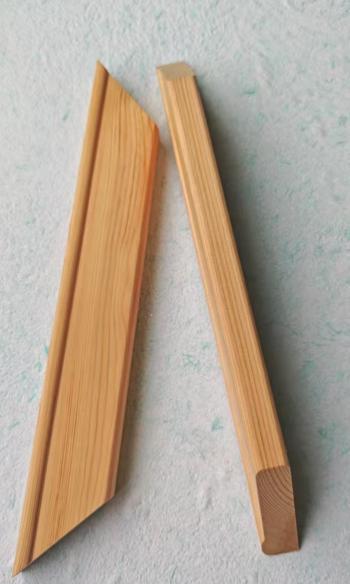
Do Tenoned Stretcher Bars Need Nails?
For standard tenoned stretcher bars, the four bars are normally assembled by fitting the machined corner joints together, so conventional frame nailing is generally not required for basic assembly. Additional reinforcement may still be used depending on frame size, profile design and application.
A keyed mortise-and-tenon stretcher relies on the joint geometry and may use wooden keys for controlled expansion. Other commercial products use tongue-and-groove or notched corner systems that can be pressed or tapped together. However, manufacturers and production teams may add fasteners, adhesive, supports or other reinforcement depending on the profile design, frame size, transport method and whether the structure is intended to remain adjustable.
Confirm the approved assembly method for the exact bar system. Do not transfer a no-nail claim from one profile to another merely because both products are described as interlocking.
Why Local Labor Cost Changes the Best Supply Format
Moving cutting or assembly to the supplier reduces destination work but adds factory processing and may change shipping volume. Outsourcing can make sense in a high-labor-cost market; it may add little value when your automated line already performs the work efficiently.
Use real cycle time, burdened labor, equipment utilization, receiving, rework and reject rate. A pre-assembled frame that arrives out of square can consume more time than a well-cut flat set; long moulding can lose its advantage through waste and inspection.
The calculation should end at cost per finished usable frame, not cost per imported component.
The Hidden Trade-Off - Labor Cost vs Freight Cost
More factory processing usually reduces work at your facility. Whether it raises freight depends on the delivered format. Cutting long profiles into flat components may improve handling without sacrificing much packing density. Joining those components into rectangles can sharply reduce density because the shipment now includes enclosed space.
Decision Factor | Long Length | Miter-Cut Flat | Pre-Assembled Frame | Tenoned / Interlocking |
Factory processing | Lower relative to finished formats | Medium: measured cutting and mitering | Higher: cutting, joining and frame inspection | Higher or profile-dependent: length cutting plus joint machining |
Local cutting labor | High | None | None | None |
Local assembly labor | High | Medium | Low | Low to medium, depending on fit and support system |
Local equipment need | High | Medium | Low | Low for basic assembly; checking and support operations may remain |
Shipping density | High, subject to long-bar packing | High for flat components | Lower because rectangles enclose empty space | High for flat sets |
Size flexibility | Very high | High before order; fixed after cutting | Medium; every frame is a finished-size unit | Standardized or profile-dependent |
Inventory complexity | Lower or dependent on profile range | Higher as finished lengths multiply | Higher as complete frame sizes multiply | Higher or dependent on standardized size program |
Why Pre-Assembled Frames Can Cost More to Ship
The reason can be understood without a freight estimate. Four loose bars can lie parallel and occupy space close to the wood, protective material and unavoidable gaps. Once joined, those four bars define a rectangle. The outside length and width now control the packing footprint even though the center contains no product.
Nesting can improve density for selected frame sizes, but corners must remain protected and frames must not distort under stacking pressure. Mixed sizes can complicate the carton and pallet plan further. For accurate comparison, request packing dimensions, units per carton, cartons per pallet where relevant, and expected container loading for each supply format. Use actual frame sizes and protection requirements; do not apply a generic percentage.
When Long-Length Material Makes More Sense
Test long moulding when you have accurate cutting and joining equipment, produce many custom dimensions and can manage offcuts across the size mix. It reduces imported finished-size SKUs and preserves late size flexibility.’
It is less attractive when woodworking capacity is limited, errors create costly rejects or the size mix produces poor yield. Review the cut list and packing method first.
When Miter-Cut but Unassembled Bars Make More Sense
This middle format suits a company that wants supplier cutting accuracy but has a good joining station. It removes local sawing and waste while preserving flat-pack shipping.
You still own the corner result. Approve the fixture, fastener, adhesive if used, diagonals and flatness; accurate components cannot compensate for inconsistent joining.
When Pre-Assembled Frames Make More Sense
Compare pre-assembled frames when labor is expensive, woodworking capacity is limited, and your operation creates more value through printing, stretching or fulfillment.
Compare packing data, freight, damage risk, storage and labor genuinely removed. Gowin’s Assembled Wooden Frames vs Stretcher Bars article provides a narrower comparison; use your real size mix.
When Tenoned Bars Make More Sense
Tenoned bars suit repeat standard sizes, flat-pack transport and simplified downstream assembly. They can fit distribution, private-label sets, retail or DIY products, and cells without frame-nailing equipment for basic corners.
They are less suitable for constantly changing dimensions or mixed joint systems. Treat each system as a compatible component family and approve fit, squareness and interchangeability.
How Production Volume Changes the Decision
A format that works for 500 frames may fail at 50,000. At higher volume, cycle time, yield, automation, handling and container utilization become important. Local automation can favor long lengths or loose parts; stable size programs may justify outsourced processing.
Do not use a universal threshold. Model your size mix, batch pattern, equipment and labor.
How SKU Count Changes the Decision
Five standard sizes create a different inventory problem from hundreds of custom dimensions. Long moulding postpones the size decision. Pre-cut bars remove work but multiply length SKUs. Assembled frames add size-specific storage; tenoned programs still require compatible lengths.
Map shared lengths, set labels and the primary inventory unit before ordering. The format must support picking and replenishment, not only production.
Quality Control Requirements Differ by Supply Format
More processing at the manufacturer’s factory shifts more acceptance criteria upstream. Less processing gives you flexibility but leaves more of the finished-frame result under your control.
Supply Format | Wood and Profile Checks | Added Dimensional Checks | Assembly Checks | Packing Checks |
Long lengths | Straightness, moisture condition, profile dimensions, raised edge and sanding | Supplied length and usable yield | Performed after local cutting and joining | Bundle protection, long-edge support, labels and handling damage |
Miter-cut loose bars | All long-length checks | Finished length, paired dimensions and miter angle | Local corner strength, diagonals, squareness and flatness | Size separation, paired-set accuracy and corner protection |
Pre-assembled frames | All material and machining checks | Outside and inside dimensions as agreed | Squareness, diagonals, corner strength, flatness and support fit | Corner protection, stacking pressure, carton dimensions and frame count |
Tenoned bars | All material and profile checks | Finished length and joint location | Joint fit, interchangeability, assembly consistency, squareness and key/support compatibility | Set completeness, size labels, component protection and instructions where needed |
Sample Approval Should Match the Supply Format
Do not approve a short loose profile when you intend to buy complete frames. The sample must reproduce the work being purchased.
- Long material: cut it with your real equipment, measure yield, machine the intended corner and build representative frames.
- Miter-cut loose parts: assemble actual size sets with your fixture and joining method, then check diagonals, flatness and canvas stretching.
- Pre-assembled frames: inspect full-size frames, supports and packing; simulate stacking, receiving and downstream stretching.
- Tenoned bars: assemble and, if relevant, disassemble representative sets; check hand or hammer fit, interchangeability, squareness and repeat assembly.
Keep the approved drawing, physical sample, packing specification and acceptance method together. A profile can pass dimensional inspection and still fail in your production sequence.
Packing Requirements for Each Supply Format
Bundled long bars need protection against bending, edge impact, moisture exposure and label loss across long packages. Flat miter-cut components need reliable size separation and protection at the cut corners. Pre-assembled frames need corner guards, stacking control and cartons that protect squareness without wasting still more volume. Retail tenoned sets may need component counting, size identification, hardware or keys where specified, instructions and private-label presentation.
Packing also affects warehouse work. Decide how your team will identify lengths, pick complete frame sets, separate customer SKUs and report shortages. Request a packing list that connects carton marking to the item and size schedule. No separate Gowin packaging or landed-cost article was linked here because a matching live destination could not be verified.
How to Calculate Which Supply Format Is Actually Cheaper
uild the comparison with the same endpoint for all four options:
- Long length: material + factory profile processing + freight + local cutting + cutting waste + local corner preparation + local assembly + rejects.
- Miter-cut flat: material + factory dimensional and miter cutting + freight + local joining + local assembly QC + rejects.
- Pre-assembled: material + factory cutting + factory joining + frame QC + higher shipping volume where applicable + receiving damage or rework + minimal local frame assembly.
- Tenoned: material + finished-length cutting + joint machining + freight + local assembly + fit-related QC + supports or keys where specified.
Then divide the complete cost by the number of frames that pass your acceptance standard. Compare total cost per finished acceptable frame. This method reveals whether a low component price is offset by waste and labor, or whether assembly savings are offset by CBM and storage.
Information to Send Before Requesting a Quote
A manufacturer cannot identify the most economical format from frame dimensions alone. Send the operating context:
- Finished frame sizes and the quantity per size
- Stretcher-bar profile drawing or confirmed width, depth and raised-edge details
- Required supply format: long length, miter-cut loose, pre-assembled or tenoned
- Canvas application and expected stretching method
- Supporting-bar layout or the sizes that require structural review
- Your cutting, joining and assembly capability
- Preferred corner system and fastener method where applicable
- Packing unit: bulk bars, paired sets, complete sets, assembled frames or retail kits
- Size labels, barcode, private-label carton and instruction requirements
- Destination market, shipping mode and preferred Incoterm
- Sample sizes and acceptance checks
Also provide your main objective: lower local labor, lower freight volume, custom-size flexibility, simpler inventory or a balance of these factors. That allows the quotation to compare realistic alternatives.
How Gowin Supports Different Stretcher-Bar Supply Formats
Gowin’s live Wooden Stretcher Bars range confirms kiln-dried pine profiles, finger-jointed construction, cutting and machining, tenoned and non-tenoned structures, supporting bars, assembled frames, custom lengths and profiles, and bulk or set packing options. Long-length profiles can be supplied up to 3 m, while Gowin’s pre-assembled frames use staples to join the mitered corners. Standard, gallery-wrap, heavy-duty and support requirements can be reviewed through the Standard Wooden Stretcher Bars, Gallery Wrap Stretcher Bars, Heavy Duty Stretcher Bars and Supporting Bars & Bespoke Profiles pages.
When you request a quotation, send the size list, profile, intended corner method, your local equipment, assembly preference and packing target. Gowin can then confirm which processing and packing formats are available for the selected profile. Exact miter-cut process, joining method, tolerances, maximum supplied length and packing CBM should be approved in the quotation and sample rather than assumed from a general product description.
Frequently Asked Questions
What is the difference between straight-cut, miter-cut and tenoned stretcher bars?
Long-length or straight profiles are supplied for local cutting and assembly. Miter-cut bars are cut to size with 45-degree ends and may be shipped loose or pre-assembled. Tenoned or interlocking bars are cut to size with machined corner features for downstream assembly. Each format places cutting, joining and QC at a different location.
Should I buy stretcher bars assembled or unassembled?
Choose after comparing local assembly cost with freight, storage and incoming-frame risk. Unassembled bars usually pack more densely and preserve local control. Assembled frames remove more destination work but occupy more shipping volume and require stronger corner and squareness protection.
Do tenoned stretcher bars need nails?
For standard tenoned stretcher bars, the four bars are normally assembled by fitting the machined corner joints together, so conventional frame nailing is generally not required for basic assembly. Additional reinforcement may still be used depending on frame size, profile design and application.
Are unassembled stretcher bars cheaper to ship?
They often use shipping space more efficiently because loose parts can be bundled without enclosing a large empty rectangle. Final freight still depends on length, profile, carton protection, quantity, route and carrier. Compare actual packing dimensions and units per shipment.
Is it cheaper to assemble canvas frames in China or locally?
There is no universal answer. Compare factory assembly cost, destination labor, freight CBM, damage or rework, equipment utilization and flexibility. Use total cost per finished acceptable frame for your actual size mix.
What equipment is needed to assemble miter-cut stretcher bars?
The equipment depends on the approved joining system. A typical operation may need a squaring fixture, V-nailer, stapler or nailing equipment, clamps, measuring tools and flatness checks. Glue or other reinforcement may also be specified. Confirm the corner method before ordering.
Should a canvas factory buy long stretcher bars or pre-cut bars?
Long lengths suit factories with efficient cutting, variable dimensions and good waste planning. Pre-cut bars suit operations that want to remove cutting and standardize dimensions. Compare equipment capacity, labor, SKU count, yield and freight rather than choosing from annual volume alone.
Which stretcher-bar format is best for high-labor-cost markets?
More factory processing may reduce expensive local work, but pre-assembled frames can increase shipping volume. Miter-cut flat or tenoned formats may provide a middle path. Model labor savings against landed freight and warehouse cost.
Can 45-degree miter-cut stretcher bars be shipped flat?
Yes. The manufacturer can cut the lengths and 45-degree ends while leaving the four components unjoined. Your facility then completes the approved corner-joining process.
Which format is best for art-supply distributors?
Standardized tenoned sets often support flat packing and easier downstream assembly. Miter-cut sets or complete frames may suit other channels. The best choice depends on the distributor’s size range, packaging, instructions, customer capability, storage and return risk.
The supply format should create the right boundary between factory processing and your operation. Long moulding maximizes local flexibility. Miter-cut loose parts remove cutting while retaining flat-pack density. Pre-assembled frames outsource more labor but carry a shipping-volume penalty. Tenoned systems combine flat packing with simplified assembly for compatible standardized ranges. Approve the option that gives you the strongest balance of production capability, labor, inventory, freight and accepted-frame cost.