
How to Choose the Right Printable Canvas Roll for Different Printing Systems
Choosing a printable canvas roll involves more than comparing GSM, surface finish or price. Two rolls with a similar weight can behave very differently when the coating, fabric construction and ink system are not the same. A canvas that produces excellent color on an aqueous pigment printer may not deliver the same adhesion, drying or finishing performance on an eco-solvent, UV or latex production line.
A practical selection process connects five factors: printer system, ink type, canvas coating, final application and finishing process. If one factor is ignored, the problem often appears later as weak color, slow drying, surface marking, cracking during stretching, excessive glare, poor winding or unnecessary material waste.
For professional production, the best canvas is therefore not the heaviest or most expensive option. It is the canvas that matches your printer, gives the required visual result, survives your finishing workflow and can be supplied consistently for repeat orders.
Why Ink System Matters When Choosing Printable Canvas Rolls
Printable canvas is a woven textile base with a receptive coating engineered to manage ink on the surface. The base fabric contributes texture, strength and dimensional stability, while the coating controls ink acceptance, color development, drying or curing behavior and resistance to handling. This is why a description such as “300gsm polyester canvas” is not enough to confirm compatibility.
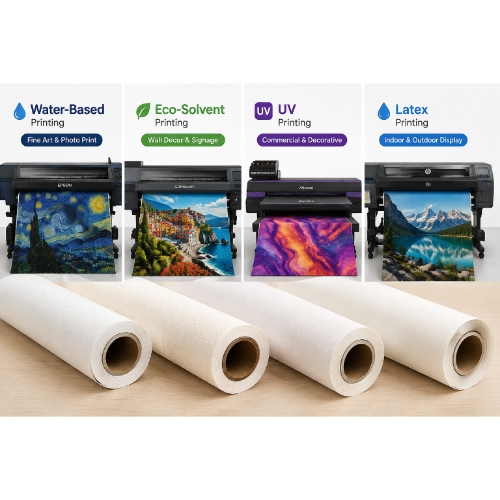
Start with the exact printer model and ink set, not only the printer brand. Epson SureColor and Canon imagePROGRAF models are commonly associated with aqueous pigment or dye workflows, while Roland and Mimaki offer many eco-solvent, UV and other wide-format configurations. HP Latex uses a water-based latex ink system with heat-assisted curing. Product selection must follow the actual machine and ink technology used in your factory.
Water-Based Printable Canvas
Water-based printable canvas is also called aqueous canvas or inkjet canvas. It is designed for aqueous dye and pigment inks, with a coating that receives the liquid ink, controls dot spread and supports color density. Pigment systems are widely used for fine art and photo production because they can provide strong image permanence when the complete ink, media and display system is suitable. Dye inks can produce vivid color, but their performance requirements may differ.
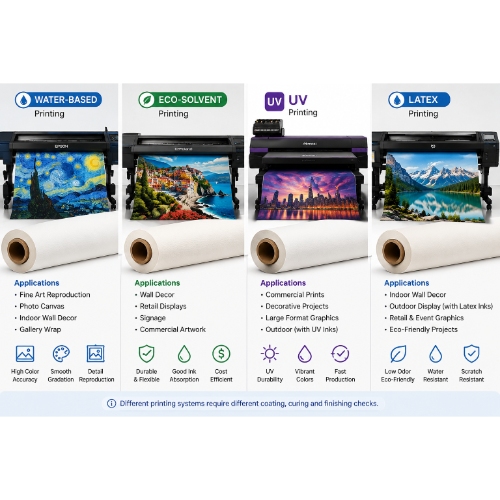
Typical applications include fine art reproduction, photo canvas, indoor wall decor and gallery wrap production. In these applications, image quality is only one part of the decision. You also need to evaluate tonal transitions, black density, neutral color, surface uniformity, drying time and how the coating behaves when the printed canvas is stretched around a frame.
For a photo canvas line, common requirements include high color accuracy, clean fine detail, good stretching and resistance to edge cracking. Cotton can provide a more traditional artistic texture for premium reproduction. Poly-cotton is often selected when you need a balance between natural appearance, stability and repeat production. Polyester can be appropriate for cost-sensitive or higher-volume production when the surface, weave and coating meet the image-quality target.
Before ordering, confirm that the printer can physically handle the canvas thickness and roll weight. Some aqueous printers support thick fine-art media through a dedicated feed path, while others are designed mainly for lighter papers. Check the media-loading method, head clearance and the printer manufacturer’s media specifications rather than relying only on the ink label.
See Water-Based Canvas Rolls for coating, material and finish options developed for aqueous pigment and dye printing.
Eco-Solvent Printable Canvas
Eco-solvent canvas is coated to support solvent-based wide-format printing, where ink adhesion, heater settings and production handling influence the result. It is commonly used for commercial wall decor, retail displays, advertising graphics, hospitality decoration and commercial artwork. These applications place more emphasis on durability, efficient production and consistent visual impact across repeated jobs.
The canvas must remain flexible after printing because many commercial prints are trimmed, rolled, mounted or stretched. A surface that looks acceptable immediately after printing may still fail if the ink layer marks during winding or cracks at a folded gallery-wrap edge. For this reason, check adhesion, scratch resistance, flexibility and finishing behavior together.
Polyester is widely used in eco-solvent production because it can provide a clean white base, stable construction and cost efficiency for volume orders. Poly-cotton can add a more textile-like appearance for decorative products. Heavier canvas may provide a more substantial feel, but the weave and coating still matter more than GSM alone.
Printer settings also matter. Heater temperature, pass mode, ink limit, RIP profile and the time allowed before finishing can change color and surface performance. When you change from one Roland, Mimaki or other eco-solvent model to another, repeat the sample test even if the canvas item number remains the same.
See Eco-Solvent Canvas Rolls for commercial printing, wall decor and wide-format canvas options.
UV & Latex Printable Canvas
UV and latex compatibility should not be treated as a separate canvas material by itself. Cotton, poly-cotton and polyester fabrics may all be used, but the coating, fabric construction and printer settings determine whether a specific roll performs reliably.
Developments in UV printing have expanded the range of flexible media that can be printed. Modern roll-to-roll systems, improved ink formulations and better curing control allow more canvas products to achieve acceptable adhesion and color. However, UV ink cures mainly at the surface, so the cured ink layer must remain flexible enough for rolling and stretching. A rigid or over-cured surface can show cracking at tight edges even when the flat print looks good.
Latex printing uses water-based ink with polymer chemistry and heat-assisted curing. The media must tolerate the printer’s curing conditions without excessive distortion, edge curl or surface change. Ink adhesion, curing, winding and odor requirements should be checked under the actual production mode, especially for long runs.
UV and latex canvas are used for commercial printing, decorative projects and large-format production. Some eco-solvent coated canvases also perform well with UV or latex systems, but this should be confirmed through testing rather than assumed from a broad compatibility statement. Printer generation, ink formulation, curing energy, temperature and profile can all affect the result.
See UV & Latex Compatible Canvas Rolls for media directions suited to modern wide-format production.
A Practical Printable Canvas Selection Framework
A clear sequence prevents you from comparing products that were designed for different jobs. Use the following process before asking for a recommended item or sample.
- Identify the exact printer and ink. Record the printer brand, model, ink technology and whether the machine uses heat, UV curing or a special media feed path.
- Define the final application. Fine art reproduction, photo canvas, gallery wraps, retail graphics and high-volume wall decor do not have the same priorities.
- Set the required performance. Decide whether color accuracy, low glare, water resistance, stretching, scratch resistance, fast handling or cost efficiency matters most.
- Choose the base material. Select cotton, poly-cotton or polyester according to the visual position, production method and target cost of the finished product.
- Choose finish, weight and width. Match the surface to the viewing environment and select a roll format that reduces trimming and downtime.
- Test the complete workflow. Print with the intended RIP and profile, then evaluate drying or curing, winding, cutting, coating, mounting and stretching before bulk production.
In short: Printer -> Ink -> Application -> Material -> Finish -> Width -> Sample Test -> Confirmed SKU. Starting with GSM or price reverses the decision process and often creates avoidable problems.
How to Choose Canvas Material: Cotton, Poly-Cotton or Polyester?
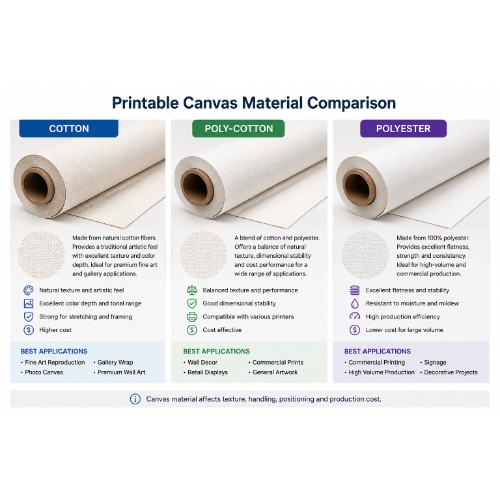
The fabric base influences texture, strength, white point, stretching behavior and product positioning. It does not replace the need for the correct coating. The comparison below describes common purchasing directions, not universal rules.
|
Material |
Best Applications |
Advantages |
Typical B2B Use |
|
Cotton |
Fine art reproduction, premium photo canvas and gallery presentation |
Natural artistic texture, premium hand feel and strong positioning for fine-art products |
When the finished print must communicate an authentic art-canvas character |
|
Poly-Cotton |
Photo canvas, gallery wraps, wall decor and versatile product ranges |
Balances textile character, dimensional stability, stretching and cost |
When one range must cover both decorative and higher-quality print applications |
|
Polyester |
Commercial production, retail graphics, cost-sensitive wall decor and high-volume projects |
Stable construction, clean white appearance, efficient handling and competitive cost |
When repeat production, lighter handling or volume efficiency is the priority |
Cotton is not automatically the best choice for every premium order, and polyester is not automatically a low-end material. A well-made polyester canvas with a suitable coating can outperform an unsuitable cotton canvas in a commercial printer. Likewise, a cotton surface may justify its higher cost when texture and fine-art presentation are central to the product.
Poly-cotton is often described as a balanced option, but the actual blend ratio, yarn, weave and coating still need confirmation. Gowin can also develop custom fabric directions, including poly-cotton constructions and options using recycled polyester, when the order volume supports custom weaving and coating.
Other Factors You Should Evaluate Before Ordering
Canvas Weight (GSM)
GSM tells you the mass of one square metre of canvas, but it does not tell you the complete structure. Coating weight, yarn thickness, weave density and fabric composition all contribute to the final number. Two 300gsm canvases may differ in thickness, stiffness, strength, texture and stretch performance.
Does GSM matter more than material? No. GSM is useful after you have confirmed the ink system, application and material direction. A lighter polyester canvas can be efficient for mounted graphics and volume wall decor, while a heavier cotton or poly-cotton canvas may provide the feel expected for premium gallery wraps. Select weight according to the finished product, not as a shortcut for quality.
Surface Finish
Surface finish affects reflection, perceived color, black density and the way customers experience the finished print. Matte reduces glare and is practical for fine art, galleries and interiors with changing light. Gloss can increase visual contrast and saturation, but reflections may become distracting in brightly lit spaces. Satin, also described as semi-gloss or semi-matt, provides an intermediate appearance.
Should you choose matte or gloss for photo canvas? Start with the viewing environment and product position. Matte is often safer for portraits, fine art and large wall displays because it controls glare. Gloss can suit vivid photography or retail imagery when stronger surface shine is part of the intended effect. Always test dark areas, skin tones and side lighting before confirming the finish.
Coating and Finishing Performance
The coating should be evaluated as part of the entire production process. Check ink absorption or adhesion, drying or curing, rub resistance and resistance to surface marking during winding. If the print will be varnished or laminated, test chemical compatibility and visual change. If it will be stretched, inspect the image at the corners and folds, not only on the flat centre area.
Different printers, ICC profiles and drying environments can produce different results. For this reason, we always recommend sample testing before mass production, especially when changing printer models, inks, coatings, heater settings or finishing methods.
Roll Width and Production Efficiency
Roll width affects material yield, trimming waste, job nesting and the number of sizes you can produce from one stock item. Match the width to the printer’s usable media width and your most common finished sizes. A wider roll is not automatically more efficient if most jobs require heavy trimming or the roll is difficult for the equipment and operators to handle.
For repeat production, also check edge quality, winding tension, core size, roll length and protective packing. Poor winding can create tracking or feeding problems even when the coating itself is correct. Stable width and clean edges are especially important when you run long jobs with limited operator intervention.
Common Mistakes When Choosing Printable Canvas Rolls
- Choosing only by price. A lower roll price can be offset by rejected prints, slower drying, excessive trimming or finishing failures.
- Choosing only by GSM. Weight does not confirm coating compatibility, weave stability, thickness or crack resistance.
- Assuming the printer brand identifies the ink system. One manufacturer may offer aqueous, eco-solvent, UV and other printer families.
- Treating broad compatibility as guaranteed performance. A canvas may print on several systems but still require different profiles, heater settings or curing conditions.
- Skipping sample testing. Printer model, ink formulation, RIP, ICC profile and environment can change the result.
- Ignoring the final application. A flat mounted graphic and a tightly stretched gallery wrap place different demands on the same printed surface.
- Evaluating only the fresh print. Check winding, cutting, stretching, coating, packing and the appearance after the print has stabilized.
How Gowin Helps You Select Printable Canvas Solutions
A useful recommendation starts with production information, not with a generic bestseller. When you contact Gowin, provide the printer brand and model, ink type, required application, preferred material, finish, width, expected order quantity and any stretching or post-coating requirements. This allows us to narrow the sample direction before you spend time testing unsuitable items.
During production, we pay attention to fabric construction, coating uniformity, surface condition, weight, width, edge quality, winding and packing. Repeat orders depend on these details remaining stable, especially when you have already built a profile and approved a finished product for your market.
Sample testing is available before bulk production. Test the sample using your normal RIP, ink load and production mode, then record color, drying or curing, adhesion, scratch resistance and finishing performance. When you change a printer, ink, coating or final application, repeat the relevant tests instead of relying on an earlier approval.
For OEM and private-label projects, we can discuss custom widths, roll lengths, labels, packing and coating adjustments. We can also develop different fabric compositions, such as poly-cotton or recycled-polyester directions, when the total order supports custom weaving and production. If a standard item is available from stock, one roll may be possible for an initial trial; custom specifications require quantity support.
Gowin has manufactured and exported canvas and related art materials since 2005. FOB and door-to-door logistics options, including DDP where available, can be discussed according to the destination and order structure. The objective is to confirm a repeatable production specification, not simply to complete one shipment.
Frequently Asked Questions
Can one printable canvas work with different printers?
Sometimes, but compatibility should be confirmed for each ink system and printer setup. Some canvases perform across eco-solvent, UV and latex workflows, while aqueous printing usually requires a coating designed for dye or pigment ink. Even when a roll is broadly compatible, settings and finishing results can differ.
Is UV printing suitable for canvas rolls?
Yes. Improvements in UV printers, flexible ink formulations and curing control have expanded canvas applications. For roll and gallery-wrap production, test adhesion and flexibility at folds because a flat print can look good even when the cured ink layer is too rigid for stretching.
What is the difference between cotton and polyester printable canvas?
Cotton provides a natural texture and premium artistic character. Polyester generally offers stable construction, a clean white appearance and cost efficiency for commercial production. The correct choice also depends on coating, weave, finish and the intended product.
How do I choose printable canvas for wall decor production?
Begin with the printer and ink, then define whether the product will be mounted, framed or stretched. For wall decor, evaluate color, glare, dimensional stability, crack resistance, width yield and repeat-order consistency. Poly-cotton is useful when you want a balanced decorative appearance, while polyester can suit volume-focused lines.
Can Gowin provide OEM printable canvas rolls?
Yes. OEM options can include width, roll length, label, packing, material direction and coating adjustments. Custom fabric or coating development requires sufficient order volume, while available stock items may be tested in smaller quantities.
Which canvas should I test first if I do not know the coating?
Send the exact printer model, ink type and final application before selecting a sample. This information is more useful than choosing a sample by GSM alone and allows the manufacturer to recommend a relevant coating and material direction.
A successful printable canvas order begins with a clear production specification. Confirm the printer, ink, application, material, finish, width and finishing method, then approve the result through sample testing. This process gives you a stronger basis for repeat orders than relying on a generic compatibility claim or a single specification such as weight.